
Think your company isn’t using AI? Think again.

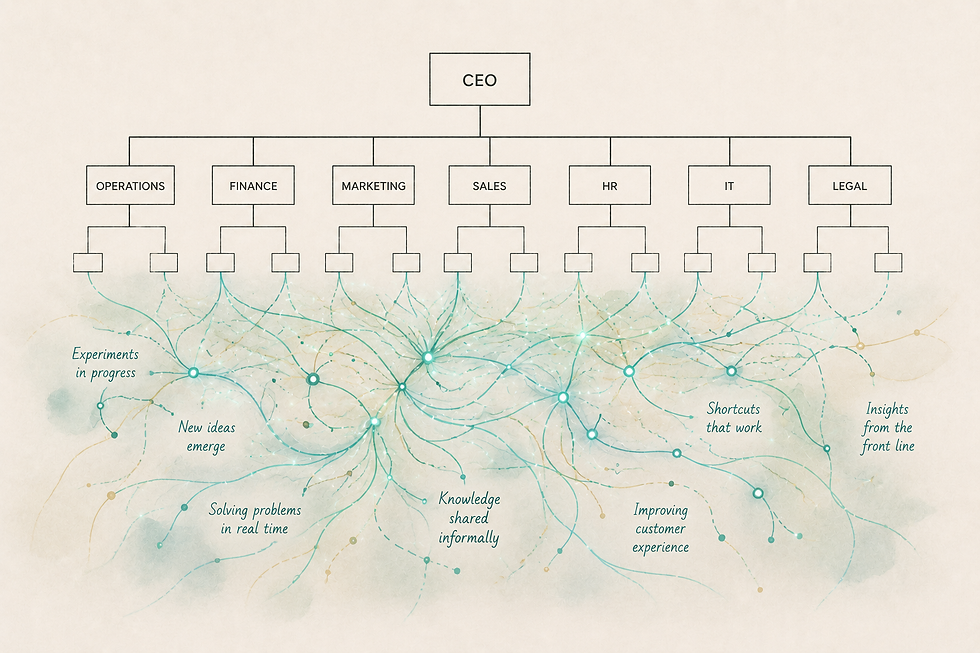
No leadership team can avoid thinking about AI right now. Some are dashing into the fray with gusto, others are following more cautiously, and others still are hoping they can carry on as they are without it.
All of these are understandable responses. But for the first time in history, employees don’t have to wait for their leadership team to decide if and how to use new technology. They can use it themselves, for anything from asking their favoured AI tool how to respond to a perplexing customer issue to getting advice on how to write a grievance letter or navigate a disciplinary issue.
That changes the communication challenge entirely.
Approaching AI as if it’s a software rollout with an accompanying training programme is not the way to think about it. Adopting AI can mean an entire reframing of how work happens inside your business in terms of expertise, value, decision-making, trust, ownership, and even identity. That means the communication challenge starts long before anyone writes an email about ‘our AI journey’.
Trying to create certainty about AI before there is shared meaning is like trying to write the minutes before the meeting has happened. Leadership teams are often under pressure to sound confident and decisive, but most AI communication currently sounds wildly optimistic, deliberately vague, or just plain scary.
ERP system rollouts of years gone by were largely about optimising efficiency. They rarely made employees ask themselves whether their judgement, creativity, or thinking still mattered. AI does. Whether leaders intend it or not, introducing AI also introduces existential conversations about value, contribution, capability, and replacement. And in many organisations, leaders do not yet have clear answers themselves.
That uncertainty matters because employees can feel the difference between a leadership team that is sharing a journey of discovery and one that is trying to project certainty it doesn’t yet possess.
In traditional change management, the leadership team selects a tool, announces the change, training happens, and adoption follows. AI adoption is different.
Many employees will already have been experimenting for months. Teams may already have unofficial workflows, preferred tools, and informal approaches while the leadership team is still formulating its position on AI. Some employees may be using AI to summarise meetings, draft presentations, analyse spreadsheets, or write first drafts of difficult emails. Others may be using it privately to help them think through challenging workplace situations or improve their productivity. In other words, AI may already be part of your organisation whether leadership has formally acknowledged it or not.
That creates a fascinating leadership challenge. How do you lead responsibly around AI in an environment where AI use is already emerging organically across the business?
Historically, expertise and authority tended to go hand in hand. The people making strategic decisions were often assumed to have the deepest practical understanding. AI disrupts that assumption. Practical understanding is likely to be distributed unevenly and unexpectedly throughout the organisation. The person beetling away at building brilliant AI-supported workflows may be nowhere near the senior leadership team, and that has significant implications for communication.
Leadership communication around AI needs to shift away from “we will tell our people how AI will work” towards “we will create a shared understanding of where AI helps, where it creates risk, and what responsible use looks like in our organisation.”
That is a very different posture from most transformations. Less broadcast, more collective sense-making. It also raises some difficult questions.
➥ How do we talk about AI and experimentation without creating fear?
➥ How do we encourage innovation without risking confidentiality?
➥ How do we avoid creating a culture in which employees hide their use of AI because they fear judgement or disciplinary consequences?
➥ How do we learn from employee experimentation rather than shutting it down?
➥ How do leaders make strategic decisions when frontline employees may currently understand some of the practical applications better than they do?
These are not purely technical questions. They are communication, trust, and leadership questions.
Employees who are already using AI may be unsure whether they are ‘allowed’ to do so. They may not fully understand what counts as commercially sensitive or confidential information. They may be making ethical decisions on behalf of the organisation every single day without even realising it.
In the absence of shared language around acceptable use, judgement, disclosure, accountability, and risk, AI can becom
e embedded in your business without anyone ever formally deciding to introduce it. That’s why AI policies alone will not solve this problem.
Policies matter, of course. Governance matters. Security matters. But policies without shared meaning rarely change behaviour in practice, particularly when people are under pressure, moving quickly, or trying to solve real operational problems.
If leaders want responsible AI adoption, they need to create environments where employees can openly discuss how they are using these tools, where the risks sit, where the opportunities genuinely help, and where human judgement still matters.
That, perhaps, is the real communication challenge around AI; not how to announce it, but how to help an organisation make collective, objective sense of AI without fear-mongering or false optimism.


Comments