
Narratives Don’t Fail at Design; They Fail in the Handoff


I work on corporate narrative for a living, which means I spend a lot of time in the gap between what organisations think they’ve said, and what people actually understand.
Organisations don’t just tell stories; they operate through them. In this context, narrative isn’t a layer on top of the business. Neither is it branding or messaging. It’s the underlying structure that shapes how people understand what’s going on, how decisions get made, and how work moves through the organisation.
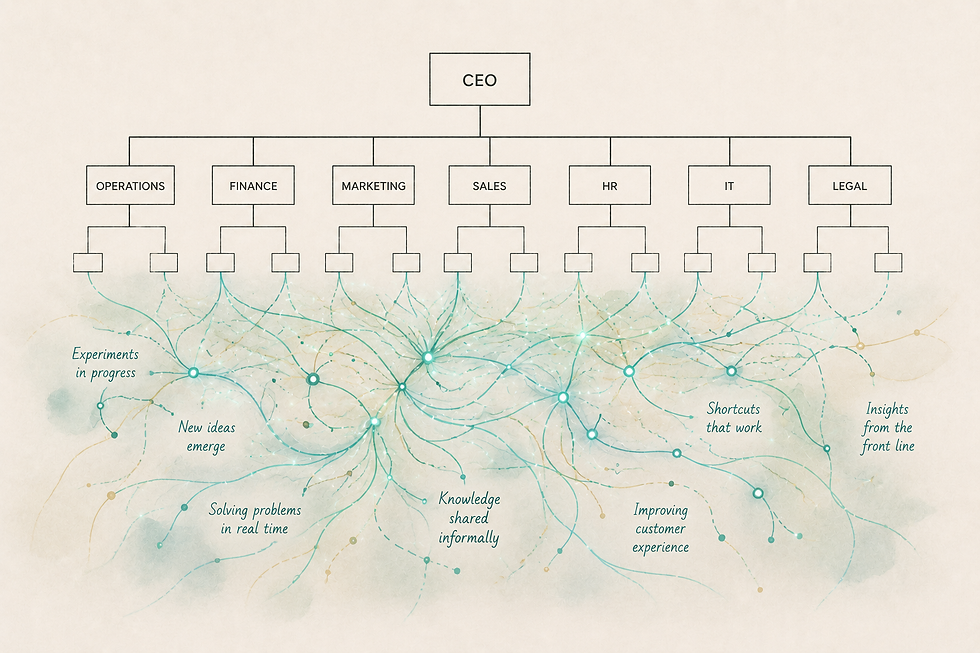
Anyone who has worked inside a large organisation knows that what people hear is often very different to what’s actually written down. And there’s a gap in how this idea is often discussed; in theory, you can design a clear, coherent narrative, but in practice, it doesn’t move through the organisation unchanged.
This is where narrative and storytelling often get confused. Narrative is the structure that makes something make sense. Stories are the moments that bring that structure to life. So you can have great stories without coherence, and you can have a clear narrative that no one remembers.
Organisations need both, but they also need to understand that they do different jobs. So let’s look at what happens once your shiny new narrative has been signed off.
What happens after the design
Once a narrative leaves the room it was created in, it starts to shift. It gets summarised, interpreted and positioned. Generally, leaders adapt the narrative for their teams, often through slides that condense it into headlines. Managers are then expected to translate it into clear priorities. Then the real test starts, because conversations reshape your narrative in real time.
And even when the narrative is crystal clear, it doesn’t land in a vacuum. People aren’t neutral recipients of company messaging. They interpret what they hear through their own incentives, risks, and agendas. None of it is malicious; it’s just how organisations work.
But it means that by the time a narrative reaches the front line, people are often working with very different versions of the same idea, and that’s where things start to drift. It’s not because the narrative was wrong; it’s because the meaning didn’t travel.
The illusion of alignment
At senior levels, it’s easy to feel confident that a narrative is landing. People nod. They repeat key phrases, and they’ve seen the deck. It all looks and feels wonderfully aligned.
Trouble is, alignment at the level of language is not the same as alignment at the level of meaning. Ask ten people what the strategy actually means for their work, and you’ll often get ten different answers. Each of them sounds pretty reasonable, and each one is slightly different. And over time, those small differences compound.
This is how organisations end up with inconsistent decisions, duplicated effort, and initiatives pulling in different directions, all the while believing they are aligned.
Where narrative actually breaks
Narratives don’t usually fail in the initial articulation; they fail in the handoff, in those moments when a leader explains it to their team, a manager turns it into priorities, and a team interprets what it means for Monday morning.
That’s where meaning is either preserved or reshaped, and in most organisations, those moments are left to chance. They assume that if the narrative is clear enough at the top, it will carry through the ranks. It rarely does, though, because clarity doesn’t survive by accident.
Why meaning changes
There are a few predictable reasons for meaning and clarity getting lost in onward transmission.
People interpret meaning through their own context
Everyone filters the narrative through what they already know, what they’re responsible for, and what they think matters. So the same message is interpreted slightly differently by many people.
Compression obscures the story
As messages move through the organisation, the narrative gets shortened. A rich explanation becomes a headline… a headline becomes a phrase… and somewhere in the compression, the clarity and nuance disappear.
Ambiguity gets filled in
Where meaning isn’t explicit, people fill in the gaps. They don’t do it randomly; they make assumptions based on their own context and incentives. This results in different parts of the organisation starting to gently drift in different directions, all in total good faith, all believing they are doing what is expected of them.
The real work of narrative
This corporate drift is why having a well-crafted narrative is just the starting point of delivering internal messages. The real work is making sure the same meaning shows up in every room it enters.
That doesn’t mean scripting your leaders. It means grounding them in the narrative so that they can explain it in their own context while landing the core idea so it’s understood in the same way across the organisation. The implications are consistently obvious to everyone, and the trade-offs are visible. That way, when people across the organisation adapt the narrative, they don’t distort it; they carry it forward.
What this looks like in practice
In practical terms, this shifts the focus from ‘Do we have a strong narrative?’ to ‘Does the meaning of the narrative hold as it moves?’
That shows up in questions such as:
➥ If I asked five leaders to explain this, would I hear the same story?
➥ If I asked five teams what this means for them, would their answers align?
➥ Where in the organisation are people interpreting this differently, and why?
The answers to those questions will tell you where the narrative is holding and where it’s fractured.
A different way to think about it
We often treat narrative as something we communicate. In reality, your corporate narrative is constantly being reshaped as everyone makes sense of it in their own way. Every conversation is a handoff; every summary is a translation; every decision is an interpretation of what people think it means for them.
The goal isn’t just to create a compelling narrative; it’s to create one that can survive the journey through the organisation and still mean the same thing.
The question that matters
Instead of asking, ‘Do we have a clear narrative?’, a better question is, ‘Does the same meaning show up in every room it enters?’ Because that’s what people actually act on, and that’s the difference between a strategy holding together or coming apart.


Comments